स्तम्भ, तोरण, बेह के बर्तन
Marriage Traditions and Wedding Ceremonies
Marriage Traditions and Wedding Ceremonies
(Patrika, Sawa-Baan, Battisi Mayra, Mayan & Ghat Vivah Traditions)
📖 Table of Contents
Manuhar Invitation Letter (मनुहार पत्रिका3
After the wedding date has been finalized, invitation letters are sent approximately three months before the wedding to family members, relatives, and friends, inviting them to attend and participate in the wedding celebrations. This invitation is known as the Manuhar Invitation Letter.
Family members, relatives, and friends living outside the town usually need to make train reservations in advance, which is why the invitation is sent about three months before the wedding.
Since local people often travel in and out of town, it is also considered appropriate to send Manuhar invitation letters to local relatives and friends.
Kumkum Invitation Letter
(For Both the Groom's and Bride's Wedding)
After sending the Manuhar Invitation Letter, a Kumkum Invitation Letter is sent about one month before the wedding date.
For this purpose, a list of invitees along with their addresses and phone numbers should be prepared in advance.
It has become customary to send Kumkum Invitation Letters to:
- Family members
- Friends
- Sisters
- Daughters
- Sons-in-law
- Close relatives
- Business associates
- Social acquaintances
- Political acquaintances
Nowadays, people do not always attend simply because they receive an invitation card. Therefore, it is advisable to personally call close friends, family members, relatives, sisters, daughters, and sons-in-law.
In addition to phone calls, SMS messages may also be sent.
Special Lagan Invitation Letter
(For the Bride's Wedding)
In earlier times, some families had the tradition of sending a special Lagan Invitation Letter for a daughter's wedding.
In this letter, all male members of the bride's family, both young and old, formally addressed all male members of the groom's family.
The wording, greetings, and details of the letter were written in a special traditional style.
This invitation was given only by the bride's family to the groom's family.
Today, this custom is rarely followed.
A sample of this invitation letter is provided for reference.
In the Tapadia family, this type of Lagan Invitation Letter is still used.
Nandimukh Ceremony
(For Both the Groom's and Bride's Wedding)
Whenever an auspicious event such as a wedding, housewarming ceremony, or religious ritual is to be performed, a Nandimukh Ceremony is conducted approximately ten days before the auspicious date. In some places, it is performed about a week before.
Performing Nandimukh protects the ceremony from interruptions caused by periods of impurity (Sutak) related to birth or death within the family.
Joyful and sorrowful events can occur unexpectedly in a family.
The possibility of a birth may sometimes be anticipated, but the timing can change. A death, however, can occur at any time.
Therefore, Nandimukh is performed to ensure that the auspicious ceremony can proceed without obstacles.
Materials Required for Nandimukh Worship
The required materials should be arranged according to the guidance of the local priest.
The worship is performed by:
- The groom's parents
- The bride's parents
- Or the person responsible for conducting the wedding or auspicious event
The ceremony is performed on an auspicious day selected in consultation with the priest.
The priest conducts the worship and rituals.
Battisi (Bhaat Invitation)
(For Both the Groom's and Bride's Wedding)
The mothers from both the groom's and bride's families visit their parental homes to invite their relatives to attend the wedding.
This custom is known as Bhaat Nyotna or Battisi.
The mother visits on an auspicious day to extend the wedding invitation.
This tradition is also called Battisi Nyotna.
Before leaving for this auspicious occasion, the mother of the groom or bride applies mehendi (henna) to her hands.
Songs are sung during the invitation ceremony.
The first five songs are dedicated to deities:
- Lord Ganesha
- Balaji
- Shyamji
- Mataji
- Ancestors (Pitarji)
After these devotional songs, invitation songs are sung.
The devotional songs are provided in Chapter 8.
Preparation for Battisi
The following items are prepared:
- ₹32
- 32 betel nuts
- 32 cloves
- 32 cardamoms
- 32 almonds
- 32 dry dates
- 32 sugar candies (Patasa)
- 1¼ kg sugar blocks (Baat)
- 1¼ kg jaggery
(If small jaggery modaks are available, eleven may be used.)
When a sister goes to invite her brother, she also carries:
- 1¼ kg rice
- 1¼ kg jaggery
Other required items include:
- Two chowkis or chairs
- Aarti plate containing roli, moli, rice, jaggery, sacred grass (doob), and water
- Sweets for the ceremonial tasting
- Gift items
- One coconut for each brother
- Gift envelopes
- An envelope for Unwari
- Saree and envelope for the sister
- Gift envelope for the son-in-law
Battisi Nyotna Ceremony
The sister seats each brother and sister-in-law together as a couple.
The sister applies a tilak to her brother and offers him sweets.
She presents a gift to her brother and gives a blouse piece to her sister-in-law.
(In the Tapadia family, blouse pieces are not given. Instead, gifts are given to the brothers and gift envelopes are given to the sisters-in-law.)
All real brothers are seated together. Each brother is then given:
- 32 betel nuts
- 32 cloves
- 32 cardamoms
- 32 almonds
- 32 dry dates
- 32 sugar candies (Patasa)
along with trays containing sugar blocks (Baat) and jaggery.
Uncles, elder family members, and maternal relatives are given a coconut and a gift envelope.
(In the Tapadia family, all brothers, including uncles and elder family members, are seated together and each receives the full set of 32 ceremonial items.)
The sister performs aarti for her brothers.
Each brother places a gift envelope in the aarti plate.
The sister then performs the Unwari ritual.
Using the same sugar blocks (Baat) and jaggery, sweet porridge (Lapsi) and Badi curry are prepared.
The sister is ceremonially offered a taste of this food.
When the sister prepares to leave, a tilak is applied to her forehead and she is draped with a saree.
If her husband (the son-in-law) is accompanying her, he is also given a tilak and a gift envelope.
Wedding Hand Ceremony and Moong Scattering
(For Both the Groom's and Bride's Wedding)
Preparations
The following items are arranged:
- One chowki (low wooden seat)
- One cushion
- Aarti plate containing roli, moli, rice, jaggery, sacred grass (doob), and water
- 1¼ kg green moong beans
- Seven plates
- Small packets of jaggery for visiting women
- Gift envelopes for Brahmin women
- Arrangements for meals or refreshments
Wedding Hand Ceremony and Moong Scattering
When the wedding preparations officially begin, the first ritual performed is the scattering of green moong beans.
This ceremony is known as Wedding Hand Taking (Vivah Haath Lena) and Moong Scattering (Moong Bikherna).
It is generally performed 5, 7, or 11 days before the wedding on an auspicious date and time.
On this day:
- Women of the family
- Sisters
- Daughters
- Maternal relatives (if they live in the same city)
are invited to participate in the beginning of the wedding ceremonies.
On the first day of the wedding rituals, mehendi is ceremonially applied to the fingernails of the groom/bride and the groom's/bride's mother.
At the auspicious time, the groom or bride is seated facing east on a chowki with a cushion.
The groom's/bride's mother and all the women attending the ceremony sit on a carpet or floor covering nearby.
The groom or bride is given a tilak.
A sacred moli thread is tied on the wrist.A small amount of jaggery is offered ceremonially.
A small amount of jaggery is offered ceremonially.
These rituals are usually performed by a paternal aunt (Bhuva) or sister.
The same lady also applies tilak and ties moli to everyone present.
The senior woman of the house, or the mother, draws auspicious symbols with roli on seven plates.
The 1¼ kg of moong beans are first given to the mother and then to six daughters-in-law of the family for sorting and selecting.
Five devotional songs are sung in honor of:
- Lord Ganesha (Vinayak)
- Balaji
- Shyamji
- Mataji
- Ancestors (Pitarji)
After the devotional songs, traditional wedding songs for the groom or bride are sung.
For a groom's wedding:
- Ghodi songs are sung.
- At the end, Sehra songs are sung.
For a bride's wedding:
- Kaman songs are sung at the end.
When the ceremony concludes, all family members are served meals or refreshments.
While leaving, guests are given jaggery.
Gift envelopes are presented to the Brahmin women.
Examples of these songs are provided in Chapter 8.
Purpose of Scattering Moong Beans
Moong beans are green in color.
Green fields are considered a symbol of prosperity, freshness, and happiness.
The purpose of scattering green moong beans is to express the wish that, just as the moong is green and flourishing, the lives of the bride and groom should also remain prosperous, joyful, loving, and full of growth.
Moong is traditionally regarded as an auspicious grain.
Invitation for Sawa, Baan, and Baan Feast
(For Both Families)
Formal invitations are given in advance for:
- Sawa Ceremony
- Baan Ceremony
- Baan Feast
Guests are invited to attend the ceremonies and participate in the meal.
The head of the family decides the menu for the Baan feast.
Family members, guests, Mayradars (maternal relatives), daughters, and sons-in-law are all warmly invited to attend and dine together.
Sawa Pujan (Wedding Commencement Worship)
(For Both the Groom's and Bride's Families)
All auspicious events are considered blessings from God.
Marriage is also regarded as a sacred and auspicious occasion.
To ensure that the wedding ceremonies are completed smoothly and without obstacles, Lord Ganesha and the family's chosen deities are worshipped at the beginning of the wedding celebrations.
This worship is known as Sawa Pujan.
Preparations for Sawa Pujan
The following items are arranged:
- Two chowkis (low wooden seats)
- Two cushions
- Two cushions for the mother and father
- Aarti plate containing roli (vermilion), moli (sacred thread), rice, jaggery, sacred grass (doob), and water
- Wedding invitation card tied with moli
- One rupee coin
- One coconut
- Batasa (sugar candy)
- Ghee in a silver bowl
- Aarti offering (Neg)
- Money pouch
Materials Required for the Worship
Materials Required for the Worship
- 7 betel leaves
- 7 betel nuts
- Roli (vermilion)
- Moli (sacred thread)
- Rice
- Jaggery
- Turmeric roots
- Cloves
- Cardamoms
- Banana
- One sacred thread (Janeu)
- Earthen Kalash (pot)
- Mango leaves
- Incense sticks
- Coconut
- Wheat
- Batasa (sugar candy)
- Pink paper
- Red cloth
- White cloth
- Rice
- Ghee
- Turmeric powder
- Flowers
- Durva grass
- Aarti plate
- Water vessel (Lota)
Sawa Pujan Ceremony
All family members, sisters, daughters, sons-in-law, and nephews are invited to attend.
Mayradars (maternal relatives of the bride or groom) and close relatives and friends are also invited.
To ensure that the wedding ceremonies are completed without obstacles, a young boy from the family is chosen as Vinayak, who is considered a symbolic form of Lord Ganesha.
From the time of Sawa Pujan until the wedding ceremonies are completed, Vinayak remains with the bride or groom.
(A real brother is not chosen as Vinayak. Usually a cousin from the paternal or maternal side is selected.)
Two chowkis are placed.
- Vinayak sits on the right-side chowki.
- The bride or groom sits on the left-side chowki.
Moong beans and one rupee coin are placed beneath each chowki.
The family elders, usually the grandfather or senior-most member, perform the worship of Lord Ganesha under the guidance of the priest.
The elders place a flower garland around the neck of the bride or groom.
Special Wedding Preparations
For the Bride's Wedding
A formal wedding document known as Lagan is written on pink paper.
For the Groom's Wedding
Yellow ceremonial rice (Peele Chawal) is prepared.
The priest mixes rice, ghee, and turmeric thoroughly until the rice turns yellow.
In earlier times, these yellow rice grains were distributed as formal invitations to people who would accompany the wedding procession (Baraat).
Today, they are distributed symbolically to four or five family members as a good omen.
Kalash Installation
An earthen pot (Kalash) is filled with water.
Mango leaves are placed inside the pot.
A coconut is placed on top.
After the worship is completed, the Kalash is placed at the location where the Mayan ceremony will later be performed.
The Kumkum Invitation Letter and wedding card, tied with moli, are also placed there.
Aarti and Songs
After the worship, the bride's or groom's paternal aunt (Bhuva) or sister performs the aarti.
As soon as the worship of Lord Ganesha begins, traditional songs are sung.
First, five devotional songs dedicated to the deities are sung:
- Vinayak (Lord Ganesha)
- Balaji
- Shyamji
- Mataji
- Pitarji (Ancestors)
After the devotional songs, wedding songs are sung.
For the Groom's Wedding
- Ghodi songs are sung.
- Banna songs are sung.
- Sehra songs are sung at the end.
For the Bride's Wedding
- Banni songs are sung.
- Kaman songs are sung at the end.
Note
Along with the Lagan invitation, turmeric roots, moong beans, and money are traditionally placed because all of these items are considered auspicious.
In earlier times, special handwritten Lagan letters were prepared in a traditional style.
Nowadays, these Lagan documents are generally written by the family priest.
स्तम्भ/ बेह के बर्तन, तोरण मंगाना (लड़की के विवाह में) :
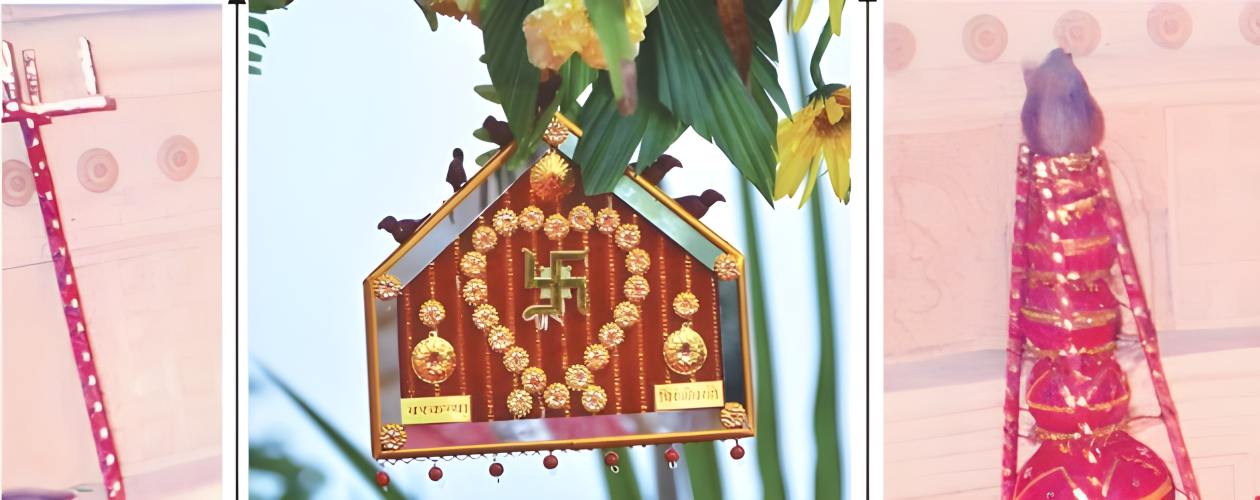
Pillars, Toran, and Beh Utensils
For the Groom's Wedding
Traditional wedding decorations include:
- Wedding pillars (Stambh)
- Toran (decorative entrance hanging)
- Beh utensils and ceremonial items
These are arranged according to family traditions and wedding customs.
Baan Ceremony
(For Both the Groom's and Bride's Families)
Nowadays, the Baan Ceremony is usually performed together with Sawa Pujan for convenience.
In earlier times, Sawa Pujan was performed several days before the wedding, while Baan was conducted closer to the wedding celebrations.
Preparations for Baan Ceremony
The following items are arranged:
- Two chowkis (low wooden seats)
- Two cushions
- One carpet
- One wooden platform (Pata)
- White cloth
- Aarti plate containing roli, moli, rice, jaggery, sacred grass (doob), and water
- Envelope for Aarti
- Envelope for Chhat
- Odhna (ceremonial cloth)
- Mortar (Ukhal)
- Pestle (Musal)
- Two Chhaylas (traditional bamboo baskets)
- Two rolling pins (Belan)
- Grinding stone or mixer grinder
- Rope made of Munj grass for Tani (nowadays sacred moli thread is commonly used)
- Blouse piece
- Rock salt pieces
- Mustard seeds
- Betel nuts
- Dry fruits
- Charcoal
- Batasa (sugar candy)
- Silver ring
- Silver Chitiya
- Betel leaf and betel nut box
- Ghee in a silver bowl
- Batasa or Mishri (rock sugar)
- Ground soaked moong dal
- Small quantity of gram (chana)
- Seven turmeric roots
- Seven coins
- Moong beans
- Barley
- Rice
- Rock salt pieces
Two types of gift packets are also prepared for the women attending the ceremony:
- One packet for Sawa
- One packet for Baan
These may contain jaggery, mishri, or any other items according to family preference.
Baan Worship Ceremony
The bride or groom sits on one chowki.
Vinayak sits on the second chowki.
The parents sit on the carpet in front to perform the worship and tie the Tani.
The priest first conducts the worship of Lord Ganesha.
A wooden platform (Pata) is placed in front of the bride or groom and covered with a white cloth.
The following items are placed in the center:
- Charcoal
- Rock salt
- Sacred grass (Doob)
- Silver ring
- Water vessel
The bride or groom personally prepares seven Badis (sun-dried lentil dumplings) from the ground moong dal.
Five to seven unmarried girls are given a tilak and are asked to prepare the remaining Badis.
The paternal aunt (Bhuva) performs the aarti of the parents.
The aarti of the bride or groom is performed by the Bhuva or sister.
A gift envelope is given to the person performing the aarti.
The bride or groom is advised to keep the silver Chitiya and betel nut box with them at all times during the wedding ceremonies.
The grandmother, elder women of the family, mother, and aunts feed the bride or groom batasa coated with ghee.
Anyone wishing to offer Baan gifts presents them at this time by applying tilak and giving money, dry fruits, sweets, or other gifts.
Dhaan Rolna (Rola–Dola Ritual)
(For Both the Groom's and Bride's Families)
Four women stand holding the four corners of an odhna (cloth).
Two cushions are placed facing each other beneath the cloth.
A small space is left between them.
On one side sits the mother of the bride or groom.
On the opposite side sit the daughters-in-law of the family, one after another.
Each woman holds a Chhayla and a rolling pin.
Sacred moli thread is tied around both the Chhaylas and rolling pins.
All participating daughters-in-law receive tilak and moli.
The mother places the following items into her Chhayla:
- Rolling pin
- Turmeric root
- Coin
- Barley
- Rice
- Moong beans
- Rock salt
She then transfers these items into the Chhayla of the daughter-in-law sitting opposite her.
The daughter-in-law transfers them back.
This exchange continues.
For convenience today, all six ritual items are often placed together in one bag, while the rolling pin is kept separate.
Seven Exchanges
The exchange is performed seven times.
At the end of the ritual, all the grains and items should remain in the Chhayla of the bride's or groom's mother.
Six daughters-in-law participate one by one with the mother.
Maternal aunts (Mami and Mausi) may also participate.
In earlier times, each of the ritual items was exchanged separately seven times.
Today, due to time constraints, all items are usually exchanged together.
Ukhal, Musal and Grinding Ritual
The mortar (Ukhal), pestle (Musal), and grinding stone or mixer are also tied with sacred moli.
Barley and gram are placed inside the mortar.
A small amount of water is added.
The same seven women who performed Dhaan Rolna now pound the grains together in the mortar.
Afterward, the grains are ground using the grinding stone or mixer.
All seven women participate by touching the grinder.
They then grind the ceremonial mehendi (henna).
If time permits, they may also apply Pithi (turmeric paste) to the bride or groom.
If time permits, they may also apply Pithi (turmeric paste) to the bride or groom.
The actual Pithi application and removal take place on the day of Virad Vinayak (Sankadi Rakhi).
Earlier Tradition
In earlier times, Virad Vinayak ceremonies lasted for five to seven days.
On the first day:
- Pithi was applied.
- Jhol ritual was performed.
- Lakh ritual was performed.
On the final day:
- Pithi was removed.
- Jhol ritual was performed again.
- Lakh ritual was completed.
During the initial days, the father helped the groom rise from the wooden platform.
On the final day, this role was performed by the maternal uncle.
Today, due to limited time, all these rituals are generally completed on the same day.
Baan Feast
(For Both the Groom's and Bride's Families)
After the completion of the Baan rituals, the entire family shares a meal together.
This meal is known as the Baan Feast (Baan ka Jeeman).
While leaving, the women of the family are given two packets:
- One packet containing jaggery
- One packet containing mishri (rock sugar)
Gift envelopes are presented to Brahmin women.
Mehendi Ceremony
(For the Bride/Groom and Mother)
After Sawa and Baan ceremonies, mehendi (henna) is applied to the hands and feet of the bride or groom.
A Sathiya (auspicious symbol) is drawn on the left hand.
A circular space approximately the size of a one-rupee coin is left empty in the center of the right palm.
The purpose of leaving this space is that during the wedding ceremony, a mehendi ball is placed between the joined right hands of the bride and groom during the Hathleva ritual.
The color of this wedding mehendi is considered important and auspicious.
The mother of the bride or groom receives mehendi on both hands and feet before the Sawa-Baan ceremony.
A Sathiya is drawn on her left hand and a Kalash design on her right hand.
The same style of mehendi is traditionally applied during other auspicious ceremonies such as:
- Jalwa
- Engagement
- Battisi
- Mayra
- Other family celebrations
Mayra Ceremony
(For the Bride/Groom and Mother)
The Mayra ceremony is one of the most important wedding traditions.
In this ceremony, the maternal family (the mother's side) visits and presents clothes, gifts, jewelry, and blessings to the bride or groom and their family.
Preparations for Mayra
The following items are arranged:
For Family Deities and Ancestors
- Clothes for the family's revered deities
- If the family has ancestral worship traditions (Pitar), clothes for them as well
(It is advisable to confirm family customs beforehand.)
For the Bride's Mother (Moda)
- One saree and chunri
- Or two sarees and blouse pieces
- Jewelry (as desired)
- Other gifts and ceremonial items
Clothes for the Bride
The following items are prepared:
- Ghaghra (traditional skirt)
- Odhna (veil/dupatta)
- Petticoat
- Blouse
- Undergarments
- Handkerchief
- Kora Bhata (a white cloth approximately 2.5 meters long)
(Kora Bhata is worn over the petticoat when the bride is dressed for wedding rituals. Later, it is dyed and converted into a chunri.)
Additional items include:
- Ivory bangles (or traditional wedding bangles)
- Nose ring (Nath)
- Jewelry (as desired)
- Anklets (Payjeb)
- Toe rings (Bichudi)
- Footwear
Clothes for the Groom
The following items are prepared:
For Family Deities and Ancestors
- Clothes for family deities
- Clothes for ancestors, if required by family tradition
For the Groom
- Safa (turban)
- Sherwani
- Kurta
- Pajama
- Vest
- Undergarments
- Handkerchief
- Socks
- Traditional shoes (Mochadi)
- Jewelry (if desired)
Clothes for the Son-in-Law and Siblings
The following may be gifted:
- Suit
- Shirt
- Tie
- Socks
- Handkerchief
- Belt
- Or Chola
- Pajama
- Jewelry
- Watch
(as desired)
Clothes and jewelry may also be given to the bride's or groom's brothers and sisters according to family wishes.
If gifts are customarily exchanged with the daughter's in-laws, then gifts are also presented to:
- Mother-in-law
- Father-in-law
- Other family members
Clothes or gift envelopes are also prepared for household helpers and staff members.
Preparations at the Sister's House
The following items are arranged:
- Two chowkis (low wooden seats)
- Two cushions
- Aarti plate containing roli, moli, rice, jaggery, sacred grass (doob), and water
- Mishri (rock sugar)
- One silver coin for tilak
- Netra
(Netra is made by combining a churning rope, silver chain, pearl garland, and sacred moli thread.)
- Sherbet served in a silver glass
The sherbet contains auspicious mishri or batasa.
The glass is covered with a red cloth.
A tray containing:
- 1¼ kg rice
- 1¼ kg jaggery
is decorated and placed before the brother.
Additional preparations include:
- Gifts according to current customs
- Flower garlands for brothers
- Gajras (flower ornaments) for sisters-in-law
The number of gifts should be arranged according to the expected attendance.
Bira Badharna and Mayra Ceremony
The sister, accompanied by women from her family, goes to the entrance singing traditional songs.
When the brother and sister-in-law arrive to perform Mayra, an auspicious saree is placed at the entrance.
This saree is known as the Moda Saree.
After entering the house:
- The brother and sister-in-law stand on a chowki.
- The sister applies tilak with a silver coin.
- She places a flower garland around her brother's neck.
- She presents a gajra to her sister-in-law.
- Nowadays, gifts are also given to both.
The sister then offers sherbet.
The sister then offers sherbet.
Holding one end of her saree along with the Netra, the sister measures her brother four times in a cross pattern.
Afterward, they embrace.
The sister then performs tilak for all present brothers, sisters-in-law, nephews, and their spouses.
She presents:
- Flower garlands
- Gajras
- Gifts
to everyone.
Chunri Ceremony
All brothers together drape a chunri over the sister.
(In the Tapadia family, all brothers from the immediate family as well as the extended paternal family participate together.)
The sister performs aarti.
The brothers place gift envelopes in the aarti plate.
One brother performs the Unwari ritual for the sister.
The sister then performs Unwari collectively for all brothers.
Afterward:
- Brothers-in-law
- Nephews
- Sons-in-law
- Other family members
receive tilak and gifts from the sister.
Mayradar Relatives
The sister also performs tilak for brothers and sisters-in-law from the Mayradar family.
She presents:
- Flower garlands
- Gifts
to them.
The sons of maternal uncles may also drape a saree over the sister.
The sister performs aarti for them as well.
They place gift envelopes in the aarti plate.
Both the sister and brothers perform Unwari for one another.
The Moda Saree used at the entrance is later given away.
If the family has ancestral traditions:
- Clothes are donated to a Brahmin for male ancestors.
- Clothes are donated to a Brahmin woman for female ancestors.
This is done before the Chunri ceremony.
Gifts to Other Family Members
After draping the chunri, the brothers present gift envelopes to:
- Sisters
- Daughters
- Granddaughters
- Daughters of daughters
Sons-in-law and nephews are also given tilak and gift envelopes.
Gifts for the Bride or Groom
The bride or groom is seated on a chowki.
Family elders apply tilak and present:
- Clothes
- Jewelry
- Other gifts brought during Mayra
The bride's or groom's parents (the daughter and son-in-law of the Mayra family) are also seated on a chowki.
They are given:
- Tilak
- Clothes
- Jewelry
- Gifts
according to family customs.
Men generally present gifts to men, while women respectfully offer gifts to women.
Refreshments are served to all guests.
According to convenience, a special meal is arranged either in the afternoon or evening.
This meal is known as Bir Bhojan.
Bir Bhojan
Bir Bhojan means a meal offered by a sister to her brothers.
It is traditionally associated with the Mayra ceremony.
If the Mayra ceremony takes place during the afternoon, Bir Bhojan may be organized in the morning or evening.
The sister personally serves food and warmly hosts:
- Brothers
- Sisters-in-law
- Nephews
- Nieces
- Maternal relatives
- Invited guests
After the wedding, gifts and sweets may be given to the Mayradar family when they return home.
Brahmin Banori and Varana
(For Both the Groom's and Bride's Families)
On the evening of the Baan day, the ritual known as Brahmin Banori is performed.
In earlier times, the Banori procession would begin from the house of a Brahmin known to the family.
Nowadays, the ceremony is usually performed at the entrance of the home.
The bride or groom is seated on a chair outside the main gate of the house.
A Brahmin offers a small piece of jaggery to the bride or groom as a ceremonial tasting.
The Brahmin then performs Khol Bharai by placing:
- One coconut
- Eleven rupees
into the lap of the bride or groom.
Returning Home in Procession
Four people hold the four corners of a cloth canopy (Chandwa) above the bride or groom.
While traditional songs are sung, the bride or groom is ceremonially escorted back into the house.
At the entrance of the house:
- The paternal aunt (Bhuva) or sister applies tilak.
- The ritual of Lun-Rai (warding off evil influences) is performed.
After entering the house:
- A lamp is lit.
- Evening devotional songs (Sanjha) are sung.
- The ritual of Varana is performed.
Banori Procession
In earlier times, after the Baan ceremony had begun, a Banori procession was taken out every evening.
Among these processions, one was known as the Brahmin Banori.
On the final day, a grand procession known as the Badi Banori was organized.
This was a festive celebration that included:
- Musical bands
- Traditional instruments
- Fireworks
- Decorated processions
For the Bride
The bride was seated in a decorated horse carriage (Bagghi).
She was taken through the entire village or town in procession.
The following people accompanied her:
- Family members
- Relatives
- Sons-in-law
- Brothers
- Important members of the community
For the Groom
The groom was seated on a horse.
He was then taken in procession through the village or town accompanied by family and guests.
Ghat Vivah
(For the Bride's Wedding)
Ghat Vivah is performed one day before the wedding.
The ceremony takes place after the completion of Brahmin Banori and Varana.
It is generally conducted after 10:00 PM at night.
This ritual is kept private and confidential.
Very few people are present during the ceremony.
Usually only the following attend:
- The bride
- The priest
- The bride's parents, or the couple who will conduct the wedding rituals
- One helper
- One household attendant
No other family members or outsiders participate.
The ceremony is performed:
- In a private room of the house
- At a secluded place within the home
- Or in a temple
No family members or guests enter the place where the ritual is being performed.
Preparations for Ghat Vivah
Some of the required items are brought by the priest.
The remaining items are arranged according to the priest's instructions.
Clothing and Items for the Bride
The bride wears:
- A simple saree (red or yellow)
- Blouse
- Petticoat
- Tiki (forehead ornament)
- Nose ring (Nath)
- Bridal bangles (Chuda)
- Anklets (Payjeb)
- Toe rings (Bichudi)
Items for the Symbolic Groom (Ghat)
The following items are arranged:
- A simple dhoti
- Chola
- Shawl
- Cap
- Handkerchief
- One earthen pot (Ghat) with a narrow opening and lid
Four sitting mats are also arranged for the ceremony.
Ghat Vivah Ritual
At the place of worship, the bride is first bathed and dressed in the new clothes prepared for the ceremony.
She is adorned with:
- Tiki
- Nose ring
- Anklets
- Toe rings
- Bridal bangles
The bride, along with her parents or the couple conducting the wedding rituals, sits for the ceremony.
The priest performs the worship.
The earthen pot (Ghat) is regarded as a symbolic form of Lord Vishnu.
The bride takes seven sacred rounds (pheras) around the Ghat.
In this way, the symbolic marriage ceremony is completed.
Completion of the Ceremony
After the worship is finished:
- The Ghat (earthen pot)
- The worship materials
- Any remaining ritual items
are immersed in a river, lake, pond, or the sea.
The bride then removes the ceremonial clothes worn during the ritual and changes back into her previous clothes.
The clothes worn during Ghat Vivah are donated to a needy person or given in charity.
The offerings, jewelry, and ritual items used during the ceremony are traditionally given to the priest.
If the priest does not accept them, they are donated along with the clothes to a poor person.
Nothing that is taken to the Ghat Vivah ceremony is brought back home.
Purpose of Ghat Vivah
Ghat Vivah is performed for the peace and remedy of certain astrological influences when a girl's planetary positions are considered particularly strong or significant.
The ritual is believed to remove obstacles and bring harmony to married life.
In the Tapadia family, Ghat Vivah is performed for every bride as a prayer for long-lasting marital happiness, prosperity, and good fortune.