Dressing Beend Raja
Traditional Pre-Wedding Rituals
Traditional Pre-Wedding Rituals and Wedding Procession Ceremonies
(Sankadi Rakhi, Pithi, Been-Beeni, Varana & Nikasi (Wedding Procession) Rituals)
📖 Table of Contents
- Bihana Ceremony
- Sankadi & Vinayak Rituals
- Bari Preparation
- Kankan-Dora Ceremony
- Pithi Ceremony
- Jhol Ceremony
- Chak Puja
- Moongdhana Badharna
- Vinayak Badharna
- Stambh Ropan
- Lakhdhan Preparation
- Been Making, Lakh Ceremony
- Binni Making, Lakh Ceremony
- Maya Tharpana
- Varana Ceremony
- Dressing Beend Raja
- Maya Dhok
- Nikasi Preparations
- Horse Worship & Nikasi
- Temple Visit
- Tootiya Ritual
Bihana (Bihana) – Groom/Bride
Preparations
- One wooden stool (Chowki)
- One earthen pot (Kalash)
- One plate
- Wheat
- Jaggery
- Green gram (Moong)
- Mehendi (Henna)
- Pithi (Turmeric paste)
- Gat (traditional sweet)
- Small packets of dry fruits
- Envelopes for Brahmin women
Bihana Ceremony
A Kalash is placed on a Chowki over a layer of Moong.
A plate containing wheat and jaggery is placed beneath the Chowki.
Mehendi and Pithi are prepared by mixing them into a paste.
Tilak is applied to all the women gathered for the ceremony.
Each woman rubs a little Pithi on her hands.
They also apply a small amount of Mehendi on their nails.
Traditional Bihana songs are sung.
These songs are sung to respectfully invoke and praise the deities.
Dry-fruit packets are distributed to all the women present.
Envelopes are given to the Brahmin women.
Sankadi Rakhi and Vinayak
Preparations
- Maya decorative panel (nowadays beautifully pre-made panels are available in the market)
- Idol of Lord Ganesha
- Cloth to drape the idol
-
Aarti plate containing:
- Kumkum (Roli)
- Sacred thread (Moli)
- Rice
- Jaggery
- Durva grass
- Water vessel
- Pink paper
- Raw cotton thread
- Kajal
- Kumkum
- 11 betel leaves
- 11 betel nuts
- Cloves
- Cardamom
- Banana
- Sacred thread (Janeu)
- Incense sticks
- Coconut
- Wheat
- Batasha (sugar sweets)
- Half metre red cloth
- Half metre white cloth
- Wooden stool (Chowki)
- Flowers
- Durva grass
- Mango branches
- Bundle of wood
- Neem branches
- Lamp
- Ghee
- Dry fruits for Vinayak's lap-filling ritual
- Clothes and envelope for Vinayak
- Lapsi (sweet porridge)
- Rice
- Badi curry
- Seven lac bangles
- Seven or eleven Rakhis
Rakhi Preparation
The Rakhi contains a protective bundle (Lun-Rai) tied in a red cloth.
The bundle includes:
- Gold
- Silver
- Iron
- Lac beads
- Cowrie shells
These items are tied into a sacred Moli thread at small intervals.
Bari Preparation (For Groom's Wedding)
In the Tapadia family tradition, the Bari includes three-and-a-half sets of bridal clothing:
- Ghaghra
- Chunari
- Four sarees
- One ceremonial Chunari
Jewellery and bridal items include:
- Ghaghra
- Chunari
- Four sarees
- One ceremonial Chunari
Additional items:
- Anklets (Payjeb)
- Toe rings (Bichudi)
- Key bracelet
- Sensoot (silver wrist ornament)
-
Four silver containers for:
- Sindoor
- Wax
- Bindi
- Glitter
Other items:
- Sehra with image of Goddess Lakshmi
- Silver-framed mirror
- Comb
- Hair oil
- Hair braid accessory
- Perfume
- Purse with money
- Footwear
- Four Gats
- Four bundles of Moli
- Four sticks of Mishri
- Suhag Puda
-
Two sets of Khol items
- One used during Bari
- One used after the wedding pheras
- Additional bridal clothing for the Phera ceremony
Kankan-Dora (Sacred Wedding Thread)
(For Groom and Bride)
Two sacred threads are prepared by twisting Moli (holy thread) and tying seven knots in each.
These sacred threads are called Kankan-Dora.
For the Groom (Beend)
- One Kankan-Dora is tied on the groom's right wrist.
- The second Kankan-Dora is tied on the groom's right ankle/foot.
- This is done during the Maya Dhok ceremony.
(For Groom and Bride)
- One Kankan-Dora is tied on the bride's left wrist.
- The second Kankan-Dora is tied on the bride's left ankle/foot.
Pithi Ceremony
(For Groom and Bride)
Preparation
A plate is prepared containing:
- Ground Pithi paste (prepared from the mixture made during the Baan ceremony)
- A small amount of turmeric
- Oil
- Water
These ingredients are mixed together into a smooth paste.
Durva grass is also placed in the plate.
Applying and Removing Pithi
Two Chowkis (wooden stools) are placed.
- Vinayak sits on the right-side Chowki.
- The groom or bride sits on the left-side Chowki.
Five or seven married women (depending on how many are present) perform the ritual.
Applying Pithi
First, Pithi is applied to Vinayak seven times.
After that, it is applied to the groom or bride seven times.
The paste is applied from bottom to top.
The women cross their hands while applying it.
The order is:
- Feet
- Knees
- Hands
- Shoulders
- Head
While applying Pithi, traditional Pithi songs are sung.
Removing Pithi
Nowadays, because of time limitations, the application and removal of Pithi are often done together.
When removing Pithi:
- The order is reversed.
- The hands are not crossed.
- The paste is removed using straight hands.
The sequence is:
- Head
- Shoulders
- Hands
- Feet
Traditional songs for removing Pithi are also sung.
Jhol Dalna (Ataan Ghalna)
(For Groom and Bride)
Preparation
A small earthen pot is prepared.
The following items are placed inside:
- Curd (slightly warmed)
- Turmeric
- Moong
- A five-rupee coin
The pot is covered with a red cloth.
A rolling pin (Belan) is placed inside.
Jhol Dalna Ceremony
The Jhol (Ataan) is traditionally brought by a married woman who has all four parents alive:
- Her own mother and father
- Her mother-in-law and father-in-law
Such a woman is considered especially auspicious for this ritual.
She brings the prepared pot containing:
- Curd
- Turmeric
- Moong
- A coin
The mixture is slightly warmed.
A rolling pin is placed inside the pot.
The pot is covered with the end of her saree (Pallu) and carried to the ceremony.
This prepared mixture is called Jhol or Ataan.
Ritual Process
First, the groom's or bride's father pours the Jhol onto Vinayak's head seven times using the rolling pin.
The mother gently rubs it into the head.
After that:
- The father pours the Jhol onto the groom's or bride's head seven times.
- The mother massages it into the hair and head using both hands.
Traditional Jhol Dalna songs are sung during the ceremony.
The woman who brings the Jhol is given a ceremonial gift (Neg).
After the ritual is completed, the groom or bride goes for a bath.
Chak Mangana and Chak Pujan
(For the Bride's Wedding)
In earlier times, people would visit the potter's house to worship the Chak (Potter's Wheel).
The Chak is the wheel used by a potter to make earthen pots.
The bride's or groom's mother performed the worship.
She offered:
- Kumkum (Roli)
- Moli
- Rice
- Jaggery
- Durva grass
She also offered money.
The potter and his wife were given:
- Tilak
- Money
- Sweets
From the potter's house, the family brought:
-
Two pots with lids
- One for Tham
- One for Bihana
- One pot for Ataan
- One pot for Maya worship
- Seven Beh pots arranged in descending sizes
A total of eleven earthen vessels were brought.
Payment for the pots was made separately.
The Beh pots and Tham pots were decorated.
Women participating in the Chak Puja carried these pots on their heads.
Usually two pots were placed on each woman's head.
Accompanied by music and traditional songs, they returned home in a procession.
When they reached home:
- Tilak was applied to the women.
- The pots were carefully removed.
- They were placed near the Maya area for future rituals.
Nowadays, these pots are generally purchased directly from the market and worshipped when needed.
Moongdhana Badharana
(For Groom and Bride)
A bundle of firewood is called Moongdhana.
Along with the bundle of wood, a fresh green Neem branch is also brought.
A servant, cook (Maharaj), barber, or helper carries the small bundle of wood on their head and stands at the entrance of the house.
The women of the family then come with an Aarti plate while singing traditional songs.
The groom's or bride's mother performs the worship of the wood bundle.
She:
- Applies tilak to the person carrying the Moongdhana.
- Gives a ceremonial gift (Neg) in an envelope.
The Moongdhana is then placed in a corner of the house.
It remains there until all the wedding ceremonies are completed.
Vinayak Badharana
(Welcoming Lord Ganesha)
(Welcoming Lord Ganesha)
The idol of Lord Ganesha (Vinayakji) is beautifully decorated and draped with a ceremonial cloth.
An unmarried girl carries the idol on her head and stands at the entrance of the house.
All the women sing traditional songs and perform the worship of Vinayakji.
The idol is then brought into the house with great respect while singing Bada Vinayak songs.
The idol is placed at the designated Maya area.
This ceremony is known as Vinayak Badharana.
The girl who carries Vinayakji on her head is:
- Given tilak.
- Presented with a gift envelope.
The complete Bada Vinayak song is traditionally sung during this ceremony.
Stambh-Ropan and Stambh Puja
(For the Bride's Wedding)
Preparation
The following items are arranged:
- Kumkum (Roli)
- Sacred thread (Moli)
- Gat
- Flowers
- Durva grass
- Jaggery
- Five betel leaves
- Five betel nuts
- 100 grams rice
- One small earthen pot with lid
- One coconut
- Two fruits
- Half metre red cloth
- Half metre white cloth
- One ceremonial pillar (Stambh)
- One empty tin container
- Soil to fill the tin container
- Seven earthen Beh pots arranged from large to small
Method
The bride's family informs the groom's family before the ceremony.
At the appointed auspicious time, the groom's family sends:
- A senior family member, or
- A son-in-law
to participate in the Stambh-Ropan ceremony.
The visiting elder or son-in-law sits for the worship.
The priest conducts the Stambh Puja through the representative sent by the groom's family.
After the worship is completed:
- Refreshments are served.
- A gift envelope is presented to the guest.
If a driver or helper accompanies them:
- They are also served refreshments.
- They are also given a gift envelope.
Lakhdhan Preparation
(For Groom and Bride)
The following items are mixed together:
- Jaggery
- Whole coriander seeds
- Cumin seeds
- Carom seeds (Ajwain)
- A piece of lac
- A piece of silver
- A piece of gold
- A piece of copper
These ingredients are shaped into a round ball similar to a laddu.
This is called Lakhdhan.
Nowadays, for convenience, Lakhdhan is usually placed inside a plastic pouch and tied with a sacred Moli thread.
Making the Groom (Been Banana), Lakh Ritual and Stepping Down from the Pata
After bathing, the groom stands on a wooden platform (Pata/Chowki).
The paternal aunt (Bhuva) or sister applies tilak to him.
Under the platform:
- Moong is placed.
- One rupee coin is placed.
A pendant or image of Lord Hanuman is placed around the groom's neck.
The same seven married women who applied Pithi now perform the Lakh ritual.
They first perform the ritual for Vinayak and then for the groom.
- The groom stands on the left side.
- Vinayak stands on the right side.
The Lakh ritual is performed seven times.
Traditional Lakh songs are sung during this ceremony.
Stepping Down from the Pata
The groom's maternal uncle (Mama) helps him step down from the platform.
An inverted earthen bowl (Sikora) is placed in front of the platform.
A Gat sweet is placed inside the Sikora.
Under the Sikora:
- Moong is placed.
- A coin is placed.
The groom breaks the Sikora and the Gat with his right foot.
The maternal uncle then gives the groom a ceremonial envelope.
Nowadays, due to time constraints, this ritual is often performed only once.
Afterwards, the groom is taken to the Maya area.
Making the Bride (Binni Banana), Lakh Ritual and Stepping Down from the Pata
After bathing, the bride is seated on a wooden platform (Pata/Chowki) and is ceremonially prepared as a bride.
- Vinayak is seated on the right side.
- The bride is seated on the left side.
Under the platform:
- Moong is placed.
- One rupee coin is placed.
After bathing, the bride is dressed in a Kora-Bhata, a plain white cloth about two-and-a-half metres long, worn over the petticoat.
A saree is then draped over it.
Nowadays, because professional makeup artists often prepare the bride later, she is not fully dressed at this stage.
The bride's sister or paternal aunt (Bhuva) applies tilak.
Then one of the senior women of the family—such as:
- Grandmother
- Elder mother (Badi Maa)
- Mother
- Aunt (Kaki)
first places a pendant or image of Lord Hanuman around the bride's neck.
If an idol or pendant of a family deity has been sent from the groom's family, it is also placed on the bride.
Wearing the Bridal Bangles (Chooda)
The bridal bangles are then worn.
First:
- Five bangles are worn on the bride's right hand.
Then:
- Six bangles are worn on the bride's left hand.
The remaining one bangle is given to the woman who helped wear them.
The bride is also adorned with:
- Nose ring (Nath)
- Sensoot (silver wrist ornament)
- Anklets (Payjeb)
- Toe rings (Bichudi)
- Footwear
Lakh Ritual
The same seven married women who applied the Pithi perform the Lakh ritual.
They first perform the ritual for Vinayak.
Then they perform it for the bride.
The ritual is performed seven times.
Stepping Down from the Pata
The bride's maternal uncle (Mama) helps her step down from the platform.
An inverted earthen bowl (Sikora) containing a Gat sweet is placed in front of the platform.
Under the Sikora:
- Moong is placed.
- One rupee coin is placed.
The bride breaks the Sikora and the Gat with her right foot.
Nowadays, due to time constraints, this ritual is usually performed only once.
Afterwards, the maternal uncle escorts the bride to the Maya area.
Maya Tharpana (Establishing the Maya)
On this day, the Maya Tharpana ceremony is performed.
The priest conducts the worship.
A decorative Maya panel is fixed onto a wooden board and placed upright against a wall.
This board is later taken to the wedding venue.
In earlier times, weddings were held at home, so the Maya was created directly on the wall.
Hand Impressions
A pink sheet of paper is fixed beside the Maya panel.
The bride or groom then makes:
- A handprint with Pithi using the right hand.
- A handprint with Mehendi using the left hand.
Below the handprints, seven marks of ghee are applied.
The remaining worship is conducted by the priest.
Seven Lavanas
A red lac bangle is placed on each of the seven Lavanas.
The bride or groom touches all seven Lavanas as part of the ritual.
Tying the Kankan-Dora
For the groom:
- Kankan-Dora is tied on the right wrist.
- Kankan-Dora is tied on the right foot.
For the bride:
- Kankan-Dora is tied on the left wrist.
- Kankan-Dora is tied on the left foot.
Gangaur Worship
After the Maya ceremony, the bride worships Gangaur Mata with seven married women.
Traditional Gangaur songs are sung.
The worship is performed in the following order:
- With Grandmother
- With Elder Mother (Badi Maa)
- With Mother
- With other married women
A total of seven women should participate.
Farewell to Vinayak
At this time, Vinayak is ceremonially bid farewell.
The bride's or groom's parents apply tilak to Vinayak.
They present:
to the child who served as Vinayak.
After this ceremony, the bride usually goes to a beauty parlour, or a beautician comes home to prepare her for the wedding.
Gangaur songs are traditionally sung during the ritual.
Varana Ceremony
In earlier times, when the wedding procession (Barat) was travelling from its camp toward the bride's home, it would stop at a crossroads.
The groom would dismount from his horse.
A carpet, cushion, and worship platform would be arranged there.
Priests from both families would perform a Panchopachar Puja and formally recite the family lineages (Gotra).
This ceremony was known as Varana.
Traditional Customs During Varana
The women of the bride's family would:
- Remove the groom's ceremonial Pithi.
- Perform the Lakh ritual with him.
The close relatives of both families would participate in a formal meeting known as Milni.
Nowadays, this ritual is generally no longer performed at a crossroads.
In the Tapadia family, Varana is performed during the wedding pheras.
In some communities, the bride's family visits the groom's home to perform Varana.
Those attending usually include:
- The bride's parents
- The couple conducting the wedding rituals
- Five to seven senior family members
- Senior members from the maternal family (Mayardar)
The ceremony is then performed at the groom's home.
Varana Preparations
Items Required for Varana
-
Worship plate containing:
- Kumkum (Roli)
- Sacred thread (Moli)
- Rice
- Jaggery
- Durva grass
- Water vessel
- Lagna Patrika (Wedding Letter)
- Gath-Joda (Sacred wedding cloth knot)
- Plate for washing the groom's feet
- Water mixed with milk
- Towel (Gamcha)
- A set of clothes for the groom
- Gift envelope for the groom
- Garland
- Money for worship
- Gift envelopes for Milni (meeting of relatives)
- Gift envelopes for the priests of both families
Varana Ceremony Procedure
After the traditional greeting ceremony (Jai Gopal), the bride's parents sit for the worship.
The groom sits facing the east direction.
The bride's parents sit facing the groom.
First, the bride's family priest ties the Gath-Joda to the bride's parents.
The priest then conducts the Panchopachar Puja of Lord Ganesha through the bride's parents.
Washing the Groom's Feet
A plate is placed before the groom.
The bride's mother pours water mixed with milk.
The bride's father washes both feet of the groom.
He then dries the feet with a towel.
After washing his hands, the bride's parents worship the groom's feet using:
- Kumkum
- Rice
The groom is then:
- Given Tilak
- Offered Jaggery
- Presented with a Garland
- Given clothes
- Given a gift envelope
Gotra Recitation
After the worship, the Gotra-Uccharan (recitation of family lineage) takes place.
First, the bride's family priest announces:
- The bride's Gotra
-
The names of three generations:
- Great-grandfather
- Grandfather
- Father
Then the groom's family priest announces:
- The groom's Gotra
-
The names of three generations:
- Great-grandfather
- Grandfather
- Father
Both priests recite the Gotras and names aloud three times.
Purpose
The purpose of the Gotra announcement is to publicly declare and introduce the family lineage and ancestry of both the bride and groom before society.
After Varana, the senior members of both families meet formally in a ceremony known as Milni.
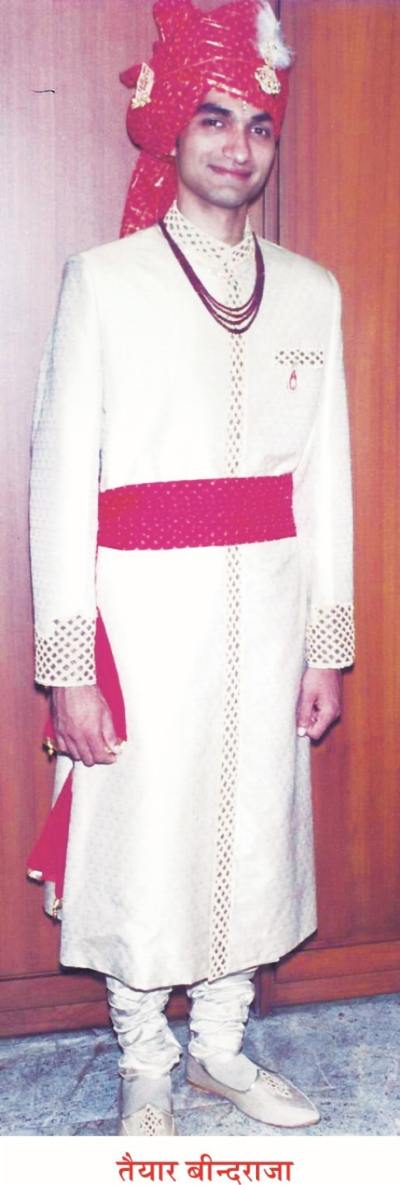
Dressing Beend Raja (Preparing the Groom)
The groom is dressed in:
- Suit or Sherwani
- Kurta
- Pajama
- New vest (Ganji)
- Undergarments
- Socks
- Handkerchief
- Gath-Joda
- Small coconut (tied around the waist)
- Kas (waist ornament)
- Safa or Pecha (turban)
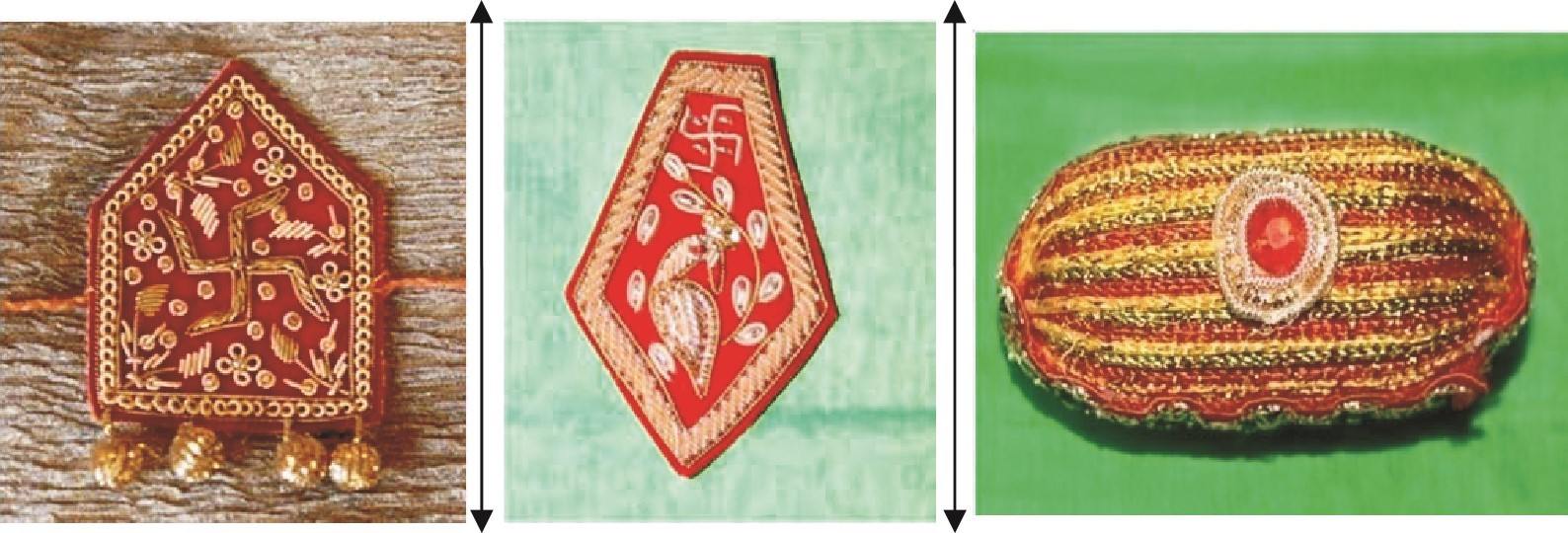
Sehra and Ornaments
Two Sehras are used:
- One marked with the Sun symbol
- One marked with Goddess Lakshmi
These are tied on the right side of the groom's turban.
The bride wears hers on the left side.
The groom is also adorned with:
- Kilangi (turban ornament)
- Katar (ceremonial dagger)
- Necklace (Kantha)
- Ring
- Tilak on the forehead
A complete dressing checklist for Beend Raja is traditionally maintained.
Maya Dhok, Gangaur Worship and Kalash Ritual
After being fully dressed, Beend Raja (the groom) offers respects to the Maya.
This is known as Maya Dhok.
This is known as Maya Dhok.
The groom worships Gangaur together with seven married women.
The worship is performed in order with:
- Grandmother
- Elder Mother (Badi Maa)
- Mother
- Other married women
A total of seven married women participate.
Traditional Gangaur songs are sung during the ceremony.
Offering Coconut
After the worship, coconuts are offered to:
- Maya
- Family deities
The sister or paternal aunt (Bhuva) performs Aarti.
This is considered the Grand Aarti (Bada Aarti).
A ceremonial gift (Neg) is given to the person performing the Aarti.
Auspicious Kalash Ritual (Soon Manana)
Before the groom leaves to mount the horse, a married woman (Suhasini) stands at the entrance.
A Suhasini may be:
- Sister
- Paternal aunt
- Married daughter
- Any married woman of the family
She holds or carries a silver Kalash containing:
- Water
- Four mango leaves
- One coconut
The Kalash is decorated with:
- Sacred thread (Moli)
- Auspicious Sankhiya designs
When the groom leaves for the horse, he places one rupee into the Kalash.
This ritual is called Soon Manana (Auspicious Blessing Ceremony).
Nikasi (Wedding Procession)
Preparations
Items Required
- Decorated horse
- Band and musical arrangements
- Fixed departure time
- Informing relatives and friends to attend
For the horse:
- Soaked gram dal (chana dal)
- One saree
Aarti plate containing:
- Kumkum
- Sacred thread
- Rice
- Jaggery
- Mehendi
- Water vessel
Other items:
- Kajal box
- Mirror
- Silver coin
- Netra (used to measure the groom ceremonially)
- Gift envelopes for rein-holding ceremony
- Aarti envelope
- Kajal ceremony envelope
- Mirror-viewing ceremony envelope
- Lun-Rai pouch
- Decorated Neem branch (for Toran ritual)
Refreshments and dry fruits are arranged for guests.
Horse Worship and Nikasi
(Groom's Side)
The groom is seated on the decorated horse.
The groom's mother first worships the horse.
She:
- Feeds soaked gram dal to the horse
- Applies tilak
- Braids or decorates the horse's mane
- Drapes a saree over the horse
- Applies Mehendi to its hooves
Blessing the Groom
The mother then:
- Applies Tilak to the groom using a silver coin
- Measures his chest four times in a cross pattern using her saree pallu and Netra
- Offers him Jaggery
- Performs Aarti
Family Rituals
The grandmother, elder mother, or mother performs the symbolic ritual of offering milk.
The aunt, sister-in-law, or other women:
- Apply Kajal
- Show the groom a mirror
All women perform Unwari (warding off evil influences).
The money used in Unwari is given to:
- The barber
- The helper
- The brother-in-law holding the horse reins
- Or another designated person
Rein Holding Ceremony
All sons-in-law present are invited to hold the horse reins.
Each is given a ceremonial gift (Neg).
A young girl is seated behind the groom on the horse.
She carries the Lun-Rai pouch and periodically performs protective rituals throughout the procession.
The women accompany the horse for a short distance while singing songs and then return home.
The groom, family members, and guests proceed toward the wedding venue.
This departure procession is called Nikasi.
Guests are served refreshments, dry fruits, and snacks.
Temple Visit
After Nikasi, the groom is first taken to a temple.
At the temple:
- A coconut is offered.
- Money is offered.
- Prayers and respects are paid.
After seeking blessings, the wedding procession continues toward the wedding venue.
Tootiya
In earlier times, while the wedding procession was away, women at the groom's home performed a traditional activity called Tootiya.
In this custom:
- One woman played the role of the groom.
- Another woman played the role of the bride.
A mock wedding ceremony was performed for entertainment and celebration.
This tradition is rarely practiced today.
List of items for Dressing BEEND RAJA
- Kilangi
- Pankh for Kilangi (not fur but of 3 tiers)
- Heera-Ekladi
- Panna-tilada haar
- Saafa - 9 mts. Min. (not saree, not georgette), cotton saafa with full starch
- Sherwani
- Kurta (without collar, length & sleeves shorter than Sherwani)
- Churidar pajama
- Socks (white or matching mochadi)
- Mochadi
- Handkerchief (white or matching Sherwani)
- Kamar Bandh
- Gath-joda
- Naryal (Small)
- Tilak
- Kas
- Sewara Two (one Sun-marked, another Laxmiji-marked) to be tied on right side of Safa/Pecha
- Kataar
- Al pins (sharp, not rusted)
- Safety-pins (all sizes, steel and brass)
- Bob pins
- Kaajal
- Compact powder
- Talcum powder
- Thread (white & red)
- Needle (medium size)
- Scissors (small)
Note: It takes one hour to get Beendraja ready.